
SEND
Our School Offer
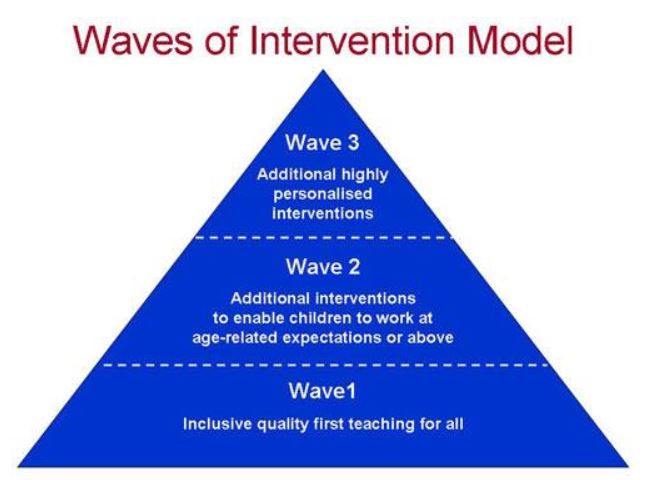
Dormansland is a mainstream primary school committed to providing an inclusive and broad education for all children in accordance with SEND 14 reforms. Special needs vary in nature and, if your child is identified as having additional requirements, appropriate provision will be made within the constraints of our present budget. Provision maps showing how we meet the needs of all children at Wave 1, school support at Wave 2 and personalised support at Wave 3 are found on the website (please see below for the model).
If a child has a special educational need, we aim to identify this as soon as possible so that we can put in the appropriate support. This may take the form of a short-term ‘catch-up’ programme, to address a difficulty with spelling or a longer-term intervention to support with speech and language or fine motor skills difficulties. We encourage all our children to become fluent readers and provide individual and small group programmes to promote this. We work in partnership with parents and carers and try to meet with them regularly. We have an experienced and well-trained team of Teaching Assistants (TAs), who work one-to-one and with small groups of children, and we invest in staff training so that programmes recommended by specialists can be carried out by our school-based staff.
Please see also our Special Educational Needs and Disabilities Policy
SEND Register
The register is ‘fluid’, meaning that once a child has made adequate progress or no longer requires additional support, they can be removed from the register. All educational institutions that are subject to the SEND Code of Practice are required to use their ‘best endeavours’ to ensure that pupils are not disadvantaged by their SEN or disability.
We will adopt a graduated approach to education, implementing an ‘assess, plan, do, review’ cycle to monitor children's’ development. If it becomes apparent that an individual is not making the expected progress, then we may make educational provision which is additional to, or otherwise different from, that for others of the same age.
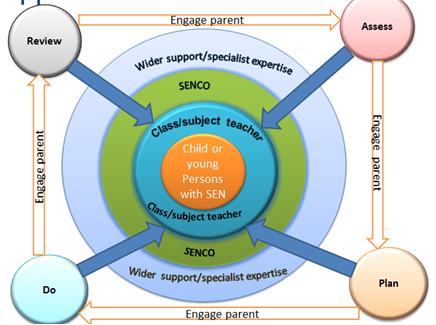
Where necessary this can include bringing in external help, for example by having an outside therapist come into the school on particular days to work with an individual or assigning a Teaching Assistant (TA) to support a child for some time in the classroom. All children on the SEND Register will have a PSP (Personal Support Plan) created for them which enables the ‘APDR’ process to develop each term.
If your child requires further support...
If a child or young person needs more support than can be provided within a school’s own resources and budgets, the school can request that the Local Authority (‘LA’) conduct an ‘EHC Needs Assessment’ of the child's SEND for the purpose of making an Education, Health and Care Plan (also referred to as an EHC plan or EHCP).
This is likely to be the case for children who present with multiple special educational needs of an interrelated and enduring nature and who require more highly specialised and personalised arrangements accessed through an EHCP in order to achieve their outcomes. The arrangements required to be put in place in order for children/young people to progress would be beyond those available through the school based core offer - i.e. the cost of the necessary arrangements would exceed £6,000.
The Local Offer
The LA Local Offer:
- The Children and Families Bill became enacted in 2014. From this date, Local Authorities and schools are required to publish and keep under review information about services they expect to be available for the children and young people with Special Educational Needs (SEN) aged 0-25. This is the ‘Local Offer’.
- The intention of the Local Offer is to improve choice and transparency for families. It will also be an important resource for parents in understanding the range of services and provision in the local area.
- Further information about Surrey County Council's Local Offer can be found on their website
How will school staff support my child?
We are a mainstream, inclusive school that fully complies with the requirements outlined in the Special Educational Needs and Disability Code of Practice (2014). Staff have been trained so as to be able to cater for learners who may have difficulties with:
- Cognition and Learning
- Communication and Interaction
- Social, Emotional and Mental Health
- Sensory and / or Physical
We make reasonable adjustments to our practices to comply with the Equality Act (2010) and have staff who have received training in the following areas:
- ELSA (Emotional Literacy)
- Precision Teaching programmes
- Supporting children’s learning in the classroom
- ADHD and ASD awareness
- Attachment and Anxiety
- Supporting families with ASD children
- Speech and Language programme
- SLCN (Speech, Language and Communication Needs)
- Lego Therapy
- Mental Health First Aiders
- Literacy For All - reading support
Our staff deliver intervention programmes to individuals and to groups of children. These change to meet the diverse needs of our children. We monitor the impact of interventions through observations, regular meetings, and tracking of pupil progress.
How will I know how my child is doing, and how will you help me to support my child’s learning?
Our Home-School Link Worker can support parents and make recommendations on how they can positively engage with their child’s learning and all round development; they can also, when appropriate, put parents in contact with outside agencies and Parenting Partnership workshops. Our Home School Link Worker team can be contacted by phone, email or in person via the school office.
What support will there be for my child’s overall well-being?
The well-being of every child is the key priority of our school and all our staff are regularly trained to provide a high standard of pastoral support. Members of staff are readily available for children who wish to discuss issues and concerns.
- We have a fully trained ELSA (Emotional Literacy Support Assistant) who implements Emotional Literacy programmes with individual children and small groups
- We regularly monitor attendance and take the necessary actions to prevent prolonged unauthorised absence.
What specialist services and expertise are available at or accessed by the school?
Our staff receive regular training and all our teachers are fully qualified. We encourage our staff to regularly update their skills and knowledge and have a number of established relationships with professionals in health and social care.
At times, it may be necessary to consult with outside agencies to receive their more specialised expertise. All external partners we work with are vetted in terms of safeguarding and when buying additional services we monitor the impact of any intervention against cost, to ensure a value for money service. We hold meetings where professionals from outside the school are invited to attend.
How will my child be included in activities outside the classroom, including school trips?
- All children are included in trips and visits as well as residential visits. We provide teaching assistant support and appropriate transport to enable this to happen. All visits are risk assessed and appropriate safety measures are put into place.
- All of our children, including those with SEN have the opportunity to attend a range of after-school clubs. We have support in place in our after-school club care.
- All children are included in the curriculum and opportunities are given readily to children with SEN. We ensure that they have opportunities to be in our children’s leadership teams, opportunities to represent the school and also be an ambassador for our school.
How accessible is the school environment?
We have an Accessibility Plan which shows how adaptations are made not only to the built environment but to the curriculum and how we can enable information to be accessed by all our learners and their parents. We value and respect diversity in our setting and do our very best to meet the needs of all our learners. We are mindful of the Equality Act 2010 and are vigilant about making reasonable adjustments where possible. Staff differentiate approaches and resources to support access to the curriculum. All ground floor rooms and playground areas are accessible for wheelchair users. A disabled toilet is available and there is a lift providing access to the second floor.
How will the school prepare and support my child to attend school, transfer to a new school or the next stage of education and life?
We have robust induction and transition programmes in place for welcoming new learners to our school and for supporting the next stage in their education. We have good relationships with local secondary schools our children move on to. Transition meetings are held with teachers and SEND Leaders from local secondary schools . At these meetings we share an overview of learners who have additional needs and SEN. Good practice is shared so that transition to the next phase is made easier. In some cases, staff from the secondary school come to work with learners to give them a familiar face for when they transfer.
A programme of visits is organised for children before they transfer, and additional transition visits are arranged for more vulnerable children. We fully encourage our children to attend induction days at secondary school and where we know that there is likely to be a high level of anxiety we send staff along for parts of the induction day. Bespoke programmes are developed for our children with special needs for the transition process and include environment, resources and curriculum access.